
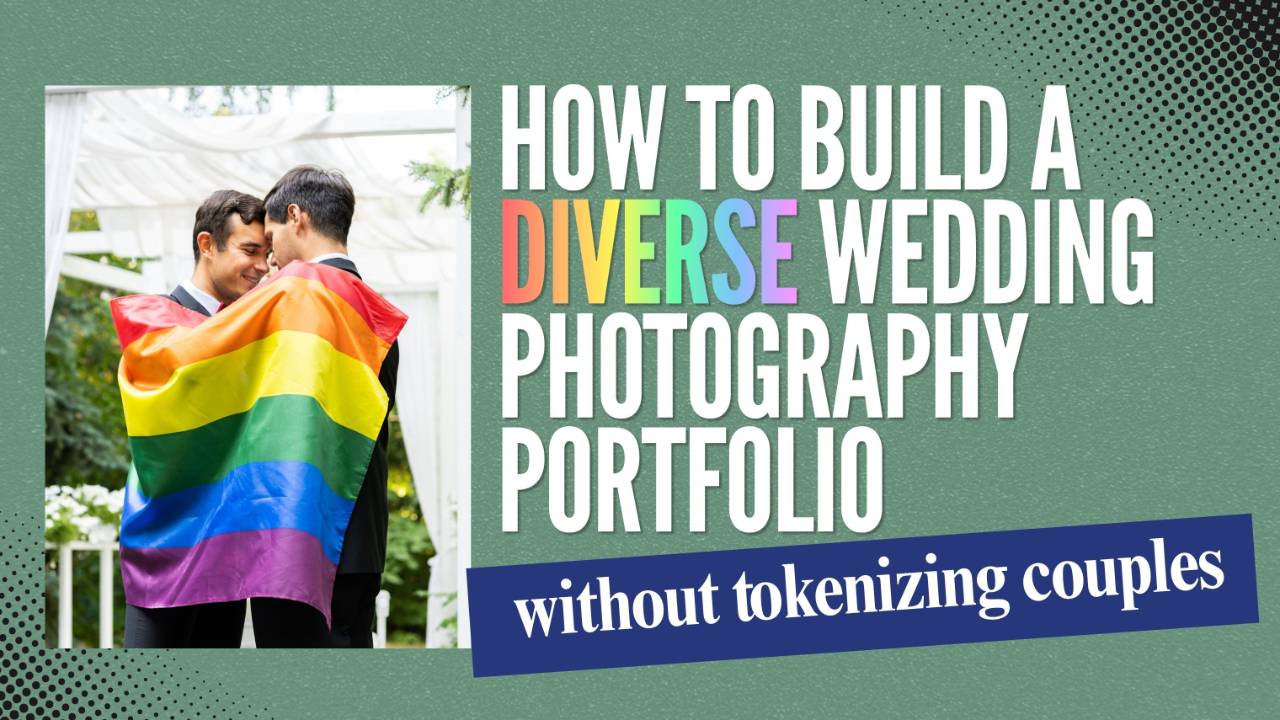
How to build a diverse wedding photography portfolio without tokenizing couples
A lot of photographers want a more diverse wedding photography portfolio.
That desire isn’t automatically bad. Your portfolio might not reflect who you want to serve, especially if you’re trying to move away from only showing thin, white, cisgender, heterosexual couples in luxury venues.
But the answer isn’t always “add more diversity to your portfolio.”
The better question is: how do you become safe and affirming enough that diverse clients can trust you?
Because diverse clients aren’t just looking for pretty photos. LGBTQIA+ wedding clients, nonbinary wedding clients, disabled clients, body diverse clients, interracial couples, and clients with complicated family dynamics are also looking for clues.
- Will I have to educate this person?
- Will I have to correct them?
- Will I have to compartmentalize parts of my identity?
- Will I have to brace for awkward questions?
- Will I have to explain myself on my wedding day?
If the answer feels like yes, they may never inquire. Even if your photos are beautiful.
So instead of starting with “How do I add these clients to my portfolio?” start with “How do I make my marketing, systems, and client experience more inclusive before they ever get in front of my camera?”
That’s the work that makes portfolio diversity possible without turning people into proof.
Why a diverse wedding photography portfolio starts with trust
A diverse wedding photography portfolio is not just a collection of different-looking couples.
It’s evidence that different kinds of people felt safe enough to hire you, be photographed by you, and let you share part of their story.
That safety starts long before the wedding day.
It starts with your website copy. Your inquiry form. Your Instagram captions. The way you talk about weddings. The assumptions you make in emails. The questions you ask on consultation calls. The way you pose people. The way you handle family photos. The accessibility of your process.
If your site says “bride and groom” everywhere, a nonbinary person may not assume you mean them.
If your contact form only offers “bride” and “groom,” queer couples may have to rewrite themselves to fit your system.
If every posing prompt assumes one person is masculine and the other is feminine, your clients may feel boxed in before you even press the shutter.
Inclusive wedding photography is not just who appears in your portfolio. It’s how people experience your business from the first click.
Styled shoots and content days are not inclusive wedding photography by themselves
Styled shoots and content days can be useful. They can help you practice, update your visuals, collaborate with vendors, and show work that’s closer to the weddings you want to photograph.
But styled shoots or content days “for diversity” can also be tokenizing if you haven’t done the work.
If the goal is simply to photograph queer people, disabled people, or body diverse clients so your website looks more inclusive, that’s not trust-building. That’s using people as a marketing asset.
The issue isn’t that styled shoots are wrong. The issue is when they become a shortcut around real change.
Before you organize a shoot to diversify your portfolio, ask:
- Have I removed bride and groom language from my website and forms?
- Do I know how to use names and pronouns correctly without making it awkward?
- Do I understand gender-inclusive and non-gendered posing?
- Have I thought about accessibility before someone has to ask?
- Do my contracts, questionnaires, and timelines make room for different family structures and relationships?
- Am I prepared to serve these clients well if they inquire tomorrow?
Your practices needs to change before your portfolio will change.
That doesn’t mean you have to be perfect, it means your business shouldn't depend on needing marginalized clients to teach you the basics.
How LGBTQIA+ wedding clients decide if you feel safe to hire
LGBTQIA+ couples are often reading between the lines.
They’re looking at whether your language includes them. They’re noticing who appears in your portfolio, but they’re also noticing how you talk about them. They’re paying attention to whether your inclusivity feels integrated or performative.
An inclusive wedding photographer doesn’t just add a rainbow emoji in June and call it done.
They make it clear, consistently, that queer and trans people are welcome, respected, and understood.
That can look like:
- Using “couples” or “partners” instead of only “brides and grooms.”
- Sharing testimonials from LGBTQIA+ wedding clients when you have permission.
- Writing captions that don’t make queer weddings sound unusual or tokenized.
- Including pronouns in questionnaires without forcing clients to disclose anything publicly.
- Knowing that not every queer client is out to every guest, vendor, or family member.
- Asking thoughtful questions privately instead of making assumptions.
This is especially important for nonbinary wedding clients. If your entire client experience assumes two gendered roles, they may decide they’re not safe with you before they ever reach out.
Safety is not built by one sentence on an About page. It’s built through repeated signals that say, “You won’t have to fight to be understood here.”
Make your wedding photography inquiry form more inclusive
Your wedding photography inquiry form is one of the first places clients learn whether your business was built with them in mind.
Small changes can make a big difference.
Instead of “Bride’s name” and “Groom’s name,” use:
- Partner 1 name
- Partner 2 name
or
- Your name
- Your partner’s name
Instead of assuming titles, ask what language people use for themselves.
You can include optional fields like:
- Pronouns, if you’d like to share
- What words do you use for yourselves or your roles?
- Are there any family dynamics, access needs, or privacy considerations you’d like me to know before we talk?
The key is to ask because it helps you care for them, not because you’re collecting personal information for marketing.
And don’t ask questions you’re not prepared to handle well.
If someone tells you they have a complicated relationship with a parent, don’t turn that into gossip. If someone shares that they use a mobility aid, don’t make it their job to redesign the entire photo plan. If someone tells you they’re not out to certain guests, don’t put them at risk with careless language.
An inclusive form should reduce labor for the client. Not create more of it.
Use gender-inclusive and non-gendered posing with every couple
Gender-inclusive and non-gendered posing is not only for queer couples.
It helps every couple feel less boxed in.
A lot of wedding posing is built on assumptions: one partner leads, one follows. One is strong, one is soft. One holds, one is held. One takes up space, one becomes smaller.
Some couples love traditional posing. That’s fine. The point is not to ban it.
The point is to stop assigning roles based on gender, body size, clothing, or your assumption about the relationship.
Try giving prompts that focus on connection instead of roles:
- Walk together and keep your shoulders touching.
- Hold each other in the way that feels most natural.
- Choose who wants to lead this movement.
- Wrap each other up like you’re trying to stay warm.
- Take turns pulling each other in.
- Show me what comfort looks like between you two.
This also matters for body diverse clients.
Don’t pose people as if their bodies are a problem to hide. Don’t assume who wants to be lifted, covered, minimized, or placed behind someone else. Don’t make a client feel like the goal is to look smaller instead of loved, present, and fully themselves.
Inclusive posing is about options, consent, and attention.
Build accessible wedding photography into your client experience
Accessible wedding photography is not just about whether a venue has a ramp.
It includes communication, planning, timelines, transportation, sensory needs, mobility, chronic illness, neurodivergence, and the amount of energy your process requires from clients.
You don’t need to know everything about every disability. You do need to stop treating access as an afterthought.
Build it into your process.
- Ask about access needs early, and make the question normal.
- Plan portrait locations with distance, terrain, seating, weather, and rest in mind.
- Offer clear timelines and expectations before the wedding day.
- Be willing to adjust posing, pacing, and photo locations.
- Avoid making clients disclose more than they want to.
- Coordinate with planners and venues when needed, instead of putting all the labor on the couple.
Accessibility is part of inclusion.
If a client has to push, explain, remind, and advocate at every step, your process is not as welcoming as you think it is.
Build portfolio diversity without turning clients into proof
You can want a more diverse portfolio and still move carefully.
The goal is not to hide your desire to serve more people. The goal is to make sure your desire doesn’t become extraction.
When you do photograph clients from underrepresented communities, get clear consent before sharing. Don’t assume a queer couple wants to be used in your Pride campaign. Don’t assume disabled clients want their access needs described in a caption. Don’t turn body diverse clients into a lesson about body positivity.
Tell the story with care, or don’t tell it publicly at all.
Also, remember that not every client needs to be a public example of your values. Some of the most affirming work you do will never be visible in your portfolio.
- It might look like using the right name in every email.
- It might look like helping a client avoid unsafe family dynamics during portraits.
- It might look like adjusting a timeline around pain or fatigue.
- It might look like not outing someone in a vendor group chat.
- It might look like making space for chosen family without making it a spectacle.
Your portfolio may change over time, but your practices need to change first.
Get the Queer-Affirming Wedding Photographer certification
If you want to become a more inclusive wedding photographer, you don’t have to figure it out by guessing.
The Queer-Affirming Wedding Photographer certification from Affirming Business Institute is built for wedding photographers who want to serve LGBTQIA+ wedding clients, nonbinary wedding clients, and other diverse couples with more care and confidence.
Inside the certification, you’ll learn how to review your language, forms, posing, marketing, and client experience so your business becomes more affirming before clients have to correct you.
You’ll also receive a 2-year directory listing so affirming clients can find photographers who are doing the work, not just using inclusive language as a trend.
This is not about becoming perfect, i’s about becoming more prepared, more thoughtful, and more trustworthy.
If you want a diverse wedding photography portfolio, start by building a business where diverse clients can feel safe being fully themselves.
Get trained and certified as a Queer-Affirming Wedding Photographer today, and reach more LGBTQ+ clients by tomorrow.
Ready to get started?
Don't miss a beat!
Sign up to get news and course updates from ABI straight to your inbox.
We hate SPAM. We will never sell your information for any reason.
Recent Posts